
DYNAMIC EVALUATION AND DISPLAY OF FREE PARKING SPACES FOR HEAVY GOODS VEHICLES
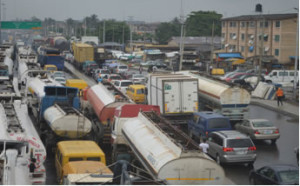
Oshodi-Apapa Expressway gridlock
With the constant traffic challenges faced by the people of Lagos State in respect to Oshodi-Apapa expressway, Complete Parking Services Ltd as at late 2014 started ongoing discussion with Ministry of Transport LASG on cost-effective technological ways to solve traffic challenges within the area.
Until 2025, goods traffic is expected to increase by more than 80 %, which will largely take place on the federal motorway network. Together with long-distance goods transports grows the demand for suited parking spaces for heavy goods vehicles (HGV) directly at or close to motorways.
With approx. 28,500 parking spaces for heavy goods vehicles at motorway service stations and just under 19,000 spaces at off-motorway rest areas, there is a deficit of nearly 15,000 parking spaces (ADAC 2013/2014). Accident statistics show that this often has fatal consequences. A significant number of accidents on motorways are caused by overtired truck drivers and accidents at service stations due to blocked access roads increase. Existing parking space for HGV must be managed in such way that it can be efficiently utilized. At the same time, the drivers must be able to plan their routes and compulsory breaks and to find parking space without tedious searching.
Creating, controlling and displaying HGV parking space is an investment in the safety of all road users. With competitive concepts Complete Parking Services makes its contribution to implement the future technology of HGV management.
Depending on the requirements, different methods and technologies are used to evaluate HGV parking spaces.
Single space method – Monitoring individual parking spaces:
- Magnetic field sensors
- Video technology
- Inductive loops
Difference method – Counting entering and leaving vehicles:
- Inductive loops
- Radar detector
- Ground radar sensor
- Magnetic field sensors
- Video technology
Tracking method – tracking individual vehicles:
- ALPR – Automatic license plate recognition (in combination with other sensor technologies)
Other methods:
- Laser scanner
- Ultrasonic sensor
- Microwave sensor
- Piezo axle sensor
- Passive infrared sensor